

There’s a common misconception that a young person who’s been through something traumatic just needs time, and the effects will eventually fade. In reality, untreated trauma in foster youth doesn’t sit quietly in the background. It moves.
It shows up in a young person’s sleep, his relationships, his ability to sit still in a classroom, and his basic sense of whether the world is safe. Understanding why mental health treatment matters starts with understanding just how far-reaching untreated trauma actually is.
How common trauma exposure really is among foster youth
Among youth in foster care specifically, an estimated 90% have experienced at least one traumatic event, and nearly half have experienced four or more distinct types of trauma. Compare that to the general youth population, where somewhere between half and two-thirds report at least one traumatic experience in their lifetime. The gap is clear: young people in care aren’t just more likely to have a trauma history they’re more likely to be carrying multiple, compounding traumas at once.
The consequences show up in the data too. Foster care alumni report meeting lifetime criteria for PTSD at nearly four times the rate of the general population with similar demographics. That’s not a minor statistical difference. It’s a signal of a population carrying a much heavier psychological load, often without adequate support to process it.
Why trauma often looks like something else first
One of the hardest parts of getting a traumatized young person the right kind of help is that trauma frequently gets misread. Consequently, a young man who explodes at a minor provocation isn’t necessarily “acting out” in the way that phrase usually implies. He may instead be responding to a nervous system stuck in threat-detection mode.
Likewise, a young person who withdraws, stops engaging, or seems chronically checked out isn’t necessarily unmotivated. He may be doing the only thing that’s ever kept him safe: disappearing. Without a trauma-informed lens, these behaviors get treated as discipline problems instead of what they actually are symptoms.
This distinction matters enormously in practice. Research has found that trauma symptoms are frequently mistaken for other mental health or behavioral concerns. As a result, a young person can end up with an inaccurate diagnosis, or with a disciplinary response, when what he actually needed was trauma-focused treatment.
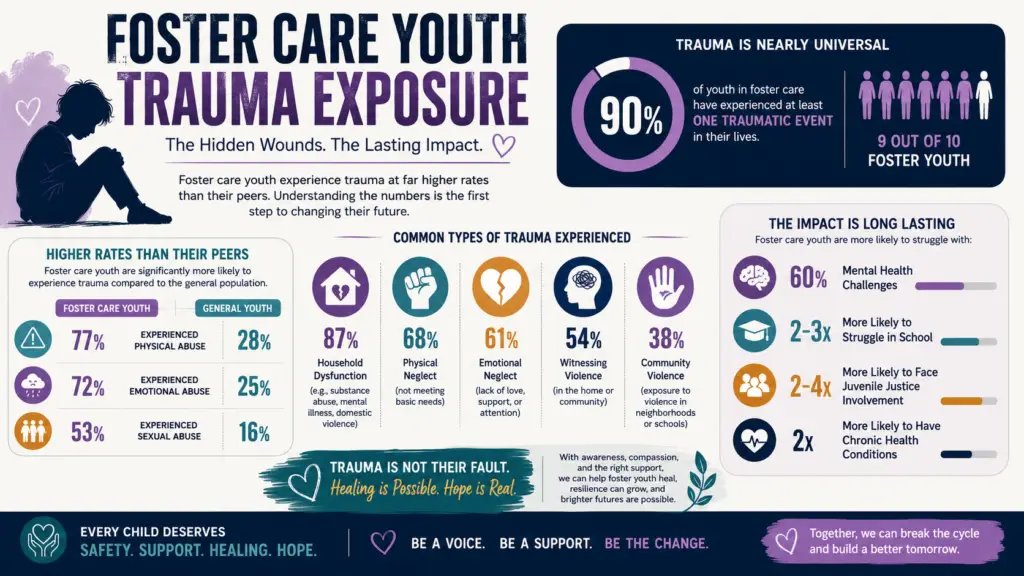
What happens when trauma goes untreated
Left unaddressed, trauma-related symptoms don’t reliably improve on their own. In fact, in some cases they get worse, particularly for youth who experienced trauma long before receiving any kind of intervention.
Untreated trauma has been linked to:
- Increased risk of placement instability
- Worsening internalizing and externalizing behaviors, such as withdrawal, self-injury, and running away
- A much higher likelihood of crisis-level mental health episodes, including emergency room visits
Nearly a quarter of youth in foster care in one recent study had visited an emergency room specifically for a mental health concern a clear sign of what happens when trauma isn’t caught and treated before it escalates.
Furthermore, the effects don’t stop when a young person leaves care. Research on Adverse Childhood Experiences has shown, consistently, that trauma left unaddressed in childhood carries forward into adult mental and physical health, often for decades.
Why treatment changes the trajectory
The encouraging counterpoint to all of this is that trauma-focused mental health treatment works. Evidence-based interventions have been shown to meaningfully reduce PTSD symptoms and depression in traumatized youth. Additionally, trauma-informed care more broadly has been linked to improvements in adult mental health, academic performance, and social functioning down the line.
Simply put, the earlier and more consistently a young person has access to real treatment not just a caring environment, but structured, evidence-based therapeutic care the more that trajectory can shift.
Why trauma-focused care has to be built in, not added on
None of this works as an afterthought. A young person can’t be expected to make progress in a program that treats mental health support as optional or occasional. Instead, it has to be structural:
- Regular individual therapy
- Staff trained to recognize trauma responses rather than punish them
- A treatment plan built around a young person’s actual history, not just his most visible behavior
That’s the difference between a program that manages behavior and one that actually helps a young person heal.
Humanistic Foundation Incorporated integrates trauma-focused mental health treatment into every resident’s individualized care plan. Learn more about our clinical approach or support this work.